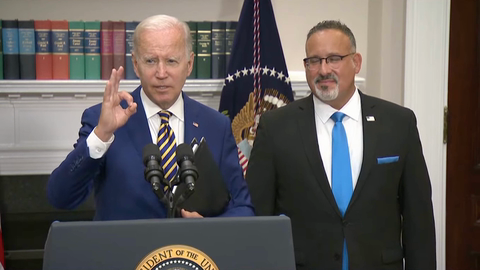
I know this is a very important issue for you. You've spent most of your career as a law professor studying the effects of debt on U.S. families. The average student loan debt in this country, as you know, is around $30,000. You did campaign on $50,000 in debt relief. So what is your reaction to this plan for $10,000?
SENATOR ELIZABETH WARREN (D-MA): My reaction is that this is a great day -- that today is the day that the President is going to announce that about 20 million Americans will never have to make another student loan payment, and another 23 million Americans will have significant relief on their student loans. Will I keep fighting for more? Of course I will. But look at what happened. It is truly transformative for tens of millions of Americans. And this problem has been very carefully targeted to meet mostly the people who have demonstrated a lot of need -- and let's just be blunt -- for whom it was hard to go to college. We're going to see $20,000 in debt relief for over half of all of the borrowers. And those are disproportionately African American, disproportionately veterans, disproportionately parents, and disproportionately first-generation students. So this is about helping America's working class, America's middle class, and really targeting that relief mostly to those who need it most.
GOLODRYGA: Let me ask you about that question as to whether this is equitable because -- especially from a racial perspective because the NAACP released this statement in response to this announcement saying: "The student debt crisis has a disproportionate impact on black borrowers and their families. Across all racial groups, black borrowers have the most student loan debt in spite of also being consistently underserved by secondary institutions." Now, I know the administration is trying to incorporate the Pell grant, given that Pell grant recipients largely compose those who are racial minorities in this country. That having been said, this is not really an endorsement from the NAACP.
Isn't this, however, just a band-aid to the larger issue at hand? And that is how we got these debts in the first place. The cost situation has skyrocketed over the past few -- you know that -- and there are real concerns as to whether colleges are actually delivering enough for Americans in terms of their future earnings.
Well, as you know, this hasn't been received well by everyone n Congress. Senator Mitch McConnell says that this plan is "a slap in the face to working class families." Let me ask you: What do you say to a family that says, "Listen, I just spent years paying off my debt. I didn't have the federal government helping me out -- bailing me out -- and now I may be doing just that for a family that at some point may be earning more than I do"?
This is yet another victory for the President and his supporters -- and, as you know, in your view, for the rest of the country as a whole -- take off your political hat on that front, everyone would like to have their loans paid down and go to college, at least most Americans would -- but it has been a successful run for the President-- you can't deny that whether on foreign policy initiatives and here at home economically, legislation. We see inflation still high, but it does appear to be peaking. Gas prices going down as well. Yet it seems that he is not benefiting at the polls for this. Why do you think that his approval ratings remain stubbornly low at this point?
WARREN: Oh, come on, haven't we learned over the past few years about the trouble with polls?
GOLODRYGA: But other Democrats -- but other Democrats are faring well. They are seeing a positive response from voters.
WARREN: What matters to me is that we are getting things done that need to be done. I mean, look at what just happened in the Inflation Reduction Act