Cross posted to the MRC's NewsBusters blog
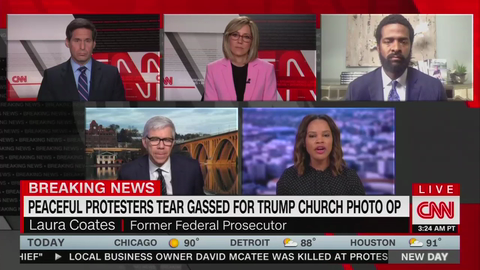
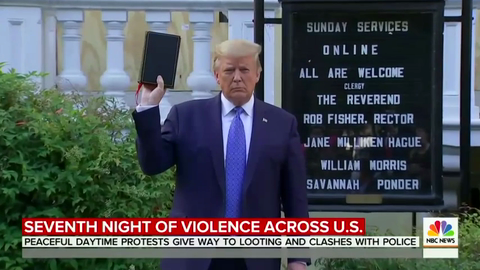
On Tuesday morning's New Day on CNN, Trump derangement syndrome was on full display as CNN regulars spread misinformation and freaked out over the dispersal rioters in Lafayette square before President Donald Trump's speech on the riots across the country.
As the group incorrectly claimed that the protesters were all peaceful and that tear gas was used against them, CNN legal analyst Laura Coates and co-anchor Alisyn Camerota both invoked the deadly Tiananmen Square massacre that killed hundreds of pro-democracy demonstrators in China over 30 years ago.
[video:https://www.mrctv.org/node/550336 align:center]
Introducing the segment, co-host John Berman claimed that "we all saw attacks on peaceful protesters" who were "tear gassed so that President Trump could take a picture in front of a church."
After liberal commentator Bakari Sellers cracked that "George Wallace is probably looking up at him with a smile," Camerota also claimed that "peaceful protesters" were "fired on with tear gas" so that "President and his attorney general and Ivanka in her heels and big designer bag could cross the street, and the President could try to figure out how to hold a Bible."
The Park Police have also denied that the dispersal was done because of the President's speech, noting that the decision was made because some protesters had turned violent and were hurling objects at police.
A bit later, Berman turned to Coates and again claimed that "peaceful protesters" were attacked and that "people's lives were endangered" so that the President could give his speech:
BERMAN: There are people whose lives were endangered for that picture, you know, tear gas, rubber bullets, flash-bang grenades, you saw people getting hit. People got hurt -- people got hurt for this picture, and yet, even if your goal is to stop the looting, I just don't get how this helps that.
In her response, after ranting that President Trump violated people's First Amendment rights, she likened the dispersal of the protesters to the Tiananman Square massacre:
LAURA COATES, CNN LEGAL ANALYST: The idea of being able to express oneself in front of the White House has been so iconic. It was converted instead to a version of Tiananmen Square. And why? Because the President wanted to have a photo opportunity. The idea that we would gas people -- gas people protesting simply to move them out of the way and then give them a speech at some point to talk about why you want to have in the military.
After complaining that the President was "dog-whistling" about the Second Amendment, Coates concluded her rant: "People were gassed -- and why? For a selfie equivalent? Its absurd."
Camerota then suggested that the President wants to use the military in a way similar to Tiananmen Square as she turned to Sellers and posed her next question:
ALISYN CAMEROTA: It doesn't feel like anything is de-escalating. As Laura points out, the President is threatening to call in active military to crack down, a la Tiananmen Square. And the protesters don't want to stop protesting until meaningful change is made. And so how does this end? Or what happens next/
Below is a transcript of relevant portions of the Tuesday, June 2, New Day on CNN:
JOHN BERMAN: This comes after we all saw attacks on peaceful protesters outside the White House. They were tear gassed so that President Trump could take a picture in front of a church.
(…)
1. who
4. absentee
5. covid gatherings dbl st
6. board member
7. ballots
5. protest
6. pepper
7. pepper
8. individual
9. fed pepper
10. fed tear
11. fed vid
12. cnn violent protests may31
13 nbc gas used sunday
14. admit throwing
15. gas and oc (video) on sunday
16. canisters on sun
17. differences, reduces violence, don't use in military to avoid escalating to other weapons
18. distinct categories
tyler hayes May 19
Nicholas Bils May 1 schiz officer resigned
Stephen O'Brien feb 24
clanto anitok jan 10
matthew krupar dec 11
Robert sikon nov 16
david ingle aug 13
margarita brooks aug 1
Joshua Ortiz july 5
Li Xi Wang july 3 marijuana bust
Luke Patterson May 23
donnell lang april 2
eric young feb 11
aaron przekop feb 8
shawn billinger jan 16
Michael ramos april 24
eliborio rodriguez nov 30 for walking in street
paul rea june 27
juan moreno june 12
henry rivera march 13
nov 1979 speech
washpost june 14, 1979: by Jane Seaberry: "Too Much Government Denounced by Reagan"
"Undeclared Republican presidential hopeful Ronald Reagan yesterday wowed a largely conservative crowd of independent business people with a denunciation of populist trends and a call for a return to more states' rights."
feb 29, 1980 University of South Carolina debate:
"While I'm a believer in states' rights, I have to recognize that there are many states that actually do not have the terrain or do not have the places that would be proper storage places for that waste."
nytimes "States' Rights Move in West Influencing Reagan's Drive" by Howell Raines:
"A Western states' rights movement that wants to force the federal government to surrender ownership of up to 544 million acres of public land has been endorsed by Ronald Reagan."
washpost "Carter: Appealing to His Native South to Again Support One of Its Own," Sept, 2, 1980, by Edward Walsh
"Beginning his general election campaign on a sweltering Labor Day in a dusty park on the banks of Tuscumbia Springs, the President appealed to Southerners as one of their own on seeking to tap the sense of regional pride that served him so well in 1976."
"Arrayed behind Carter on the speaker's platform in Spring Park were some familiar faces from an older South -- former Alabama Governors George Wallace and 'Big Jim' Folsom and former Senators James O. Eastland of Mississippi, John Sparkman of Alabama, and Albert Gore of Tennessee."
James eastland
john glenn
2018 2019
California -- 114 135
Texas -- 85 108
Florida -- 64 64
New York -- 15 23
Illinois -- 20 13
Pennsylvania -- 23 14
Ohio -- 32 24
Georgia -- 44 37
North Carolina -- 25 34
Michigan -- 21 13
New Jersey -- 12 12
Virginia -- 18 10
Washington -- 22 36
Arizona -- 62 35
Tennessee -- 26 33
2016 jun7
1st response
immediate aftermath
while libs have become infamous for pouncing on police violence cases and pronouncing the cops guilty before all the facts are even out, c tend to give benefit of doubt until more facts are revealed -- facts which often don't materialize until the actual trial
n jul7
cn jul10
wapo t2016 july7
july7a preview on radio
july7b waiting more info
july7c another article
july10 not rep
Massachusetts -- 3 5
jun17b fr
jun21 fr
jul4 disagreed
Josephine byrd
Otis mcdonald
mary shepard
shaneen allen
cn 2016jul10
cn 2017jun18
cn 2017jun21
2017 j28
2017 jul23
every day
used earlier
Indiana -- 18 16
Maryland -- 12 19
Missouri -- 24 28
Wisconsin -- 12 18
Colorado -- 44 36
South Carolina -- 12 18
Minnesota -- 12 11
Alabama -- 13 11
Louisiana -- 15 20
Oregon -- 17 18
Kentucky -- 20 15
Oklahoma -- 33 35
Connecticut -- 1 4
Nevada -- 22 11
Utah -- 18 12
Kansas -- 7 9
Arkansas -- 21 21
Iowa -- 9 5
Mississippi -- 10 18
New Mexico -- 20 19
Nebraska -- 1 6
West Virginia -- 7 13
Hawaii -- 11 7
New Hampshire -- 20 2
Maine -- 3 3
Idaho -- 13 7
Montana -- 6 6
Rhode Island -- 1 0
Alaska -- 7 7
Delaware -- 0 2
Vermont -- 2 3
North Dakota -- 4 0
South Dakota -- 3 3
Wyoming -- 4 1
Over the past week, as journalists have been fixated on the timing and location of President Donald Trump's campaign rally on Juneteenth weekend in Tulsa, Oklahoma, journalists and liberal commentators have again been peddling the debunked myth that President Ronald Reagan launched his 1980 presidential campaign in Philadelphia, Mississippi, to appeal to racist whites.
Citing the fact that Tulsa was a city where a horrific mass murder of black residents occurred in 1921, a number of figures on MSNBC have likened the Trump rally to Reagan's 1980 campaign event.
The myth that Reagan campaigned at a site where civil rights activists were murdered so he could appeal to white racists is wrapped in three falsehoods.
First, liberals try to hype the timing of the August 3, 1980, speech by claiming that this was either Reagan's very first campaign event where he announced his candidacy for President, or that it was his first appearance after the Republican National Convention -- neither of which is true. HIs campaign announcement had come more than eight months earlier in November 1979. And his Philadelphia speech came after several other campaign stops in the aftermath of the July convention, so it wasn't even the beginning of his general election campaign.
Secondly, rather than being held at a location that was just known for being near an infamous murder scene, the speech was held at the biggest public event in the state, the Neshoba County Fair, which was the best place to get exposure to voters from all over the state at a time when the Mississippi was more competitive in presidential elections. In fact, Democrats John Glenn and Michael Dukakis also campaigned there years later as they ran for President.
Third, Reagan's speech did not deal with racial or civil rights issues, but, in fact, was focused on the federal government's tendency to dictate to state governments on economic and education issues. This was consistent with his previous history of speaking in favor of "states' rights" while complaining that the federal government collects too much tax revenue from the states and then only gives some of it back with strings attached.
And, contrary to how journalists portrayed it, Reagan's use of the term "states' rights" was not a phrase he only uttered near Southern whites who might have supported George Wallace when, in fact, he had a documented history of sometimes using the phrase in other venues that would have reached plenty of non-Southerners as well.
On February 28, 1980, he used the term during one of the Republican presidential debates that, according to moderator Jim Lehrer, was being broadcast on PBS stations in South Carolina, but was "also being carried elsewhere in the country on many station members of the Public Broadcasting Service."
Liberal columnists William Raspberry and Jack Germond took part in moderating the debate, but there's no sign that any journalists took notice of Reagan's use of the phrase "states'' rights" as he answered a question about whether states should be able to refuse to accept nuclear waste: "While I'm a believer in states' rights, I have to recognize that there are many states that actually do not have the terrain or do not have the places that would be proper storage places for that waste."
Earlier in the debate, the candidates were notably invited to make a pitch for the votes of black South Carolinians, leading Reagan to brag about his history of appointing blacks when he was governor of California.
And, as far back as 1967, he discussed the issue of "states' rights" with conservative author William F. Buckley, Jr., on the syndicated show, Firing Line, which at the time was mostly seen in New York.
Reagan also used the phrase in a number of speeches while he was President.
What makes so brazen the effort by liberals to twist Reagan's harmless speech into being racist is the fact that then-Democratic President Jimmy Carter himself made a campaign appearance with actual prominent segregationists on Labor Day as he shared a stage with former Alabama Governor George Wallace, former Alabama Senator John Sparkman, and former Mississippi Senator James O. Eastland in Alabama.
Eastland, of particular note, had notoriously dismissed the disappearances of Chaney, Goodman, and Schwerner as a "publicity stunt" when they were first reported missing when he was a U.S. Senator in 1964.
How does a vile shutdown of peaceful protesters in front of the White House so the President can take a picture -- how does that make it better?
BAKARI SELLERS, CNN POLITICAL COMMENTATOR: ...Look, yesterday the President of the United States used tear gas -- he used the military against peaceful protesters. The only thing I could think of is that George Wallace is probably looking up at him with a smile.
(…)
ALISYN CAMEROTA: The optics, the visual, the symbolism yesterday of what happened was just so strange on every level. Peaceful protesters being fired on with tear gas. I actually see police also using their baton against some of the protesters so that the President and his attorney general and Ivanka in her heels and big designer bag could cross the street, and the President could try to figure out how to hold a Bible. it was so strange, and, I mean, has anyone ever looked more uncomfortable holding a Bible?
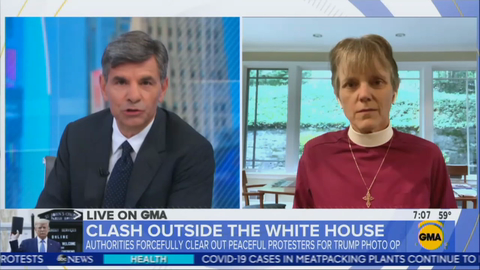
And one of the people of the clergy was very upset was the bishop who overseas that church. And so the Episcopal bishop of the diocese said that she was outraged and basically appalled by what she was seeing by the Bible being used as a prop and the church being used as a backdrop.
(…)
BERMAN: Even if your goal is to stop the looting, even if your goal is to dampen some of the tensions we've seen, how is putting lives at risk in front of the White House -- how does it help that end, Laura? There are people whose lives were endangered for that picture, you know, tear gas, rubber bullets, flash-bang grenades, you saw people getting hit. People got hurt -- people got hurt for this picture, and yet, even if your goal is to stop the looting, I just don't get how this helps that.
LAURA COATES, CNN LEGAL ANALYST: Because it doesn't, John, because all it does essentially is take what has been the most iconic public forum -- the place where people are able to express themselves -- are able to engage in the purposeful protest across this country -- there is no more fundamental right we talk about here in the United States of America than the freedom of speech.
That's all part of the First Amendment that actually has five powers -- freedom of press, freedom to assemble, freedom to petition one's government. The idea of being able to express oneself in front of the White House has been so iconic. It was converted instead to a version of Tiananmen Square. And why? Because the President wanted to have a photo opportunity. The idea that we would gas people -- gas people protesting simply to move them out of the way and then give them a speech at some point to talk about why you want to have in the military.
(…)
COATES: But what is being talked about is excessive force, fundamentally excessive force. And so your solution to trying to show top down what the government stance is on excessive force is to violate the Constitution and the First Amendment, and then to use excessive force to make your point. It is absurd, is what it is, and then you've got the notion that -- in the one hand, in a speech, John, he wasn't talking about the First Amendment. He kind of signaled, "And your Second Amendment rights," as if that was supposed to be some way of conveying or insinuating something -- maybe it was dog-whistling -- I don't know what it was.
But what it was not was the leader of the executive branch of government whose job it is to enforce the law, and the President of the United States arguing instead as commander in chief to look at protests through the prism of combat and threaten to send in the military. It is something that will never be -- that I have never seen before. Many people looking at this and wondering and disoriented: "What country is this? What sidewalk was that?" Because surely it couldn't have been in front of the White House which I know we've always termed "the people's house." It wasn't yesterday. People were gassed -- and why? For a selfie equivalent? Its absurd.
ALISYN CAMEROTA: Bakari, it doesn't feel like anything is de-escalating. As Laura points out, the President is threatening to call in active military to crack down, a la Tiananmen Square. And the protesters don't want to stop protesting until meaningful change is made. And so how does this end? Or what happens next?
. Katie Moon
. Craig Millward