Cross posted to the MRC's NewsBusters blog
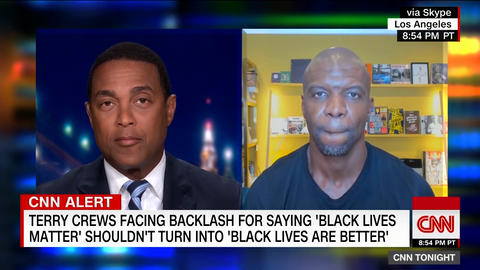
On Monday's CNN Tonight, Don Lemon defended the Black Lives Matter movement's tendency to ignore the large numbers of black Americans who are murdered by other blacks as the liberal CNN anchor debated actor Terry Crews for recently criticizing the left-wing activist group on Twitter.
After Crews argued that "all black lives" should matter to BLM, Lemon rationalized the liberal activist group's priorities:
[video:https://www.mrctv.org/node/551572 align:center]
DON LEMON: The Black Lives Matter movement was started because it was talking about police brutality. If you want an "All Black Lives Matter" movement that talks about gun violence in communities, including, you know, black communities, then start that movement with that name, but that's not what Black Lives Matter is about. It's all-encompassing.
Lemon was actually incorrect in stating that BLM was first formed to react to police-involved killings of blacks when, in fact, it was started after George Zimmerman -- a Hispanic civilian -- killed black teen Trayvon Martin in 2012, leading many liberal activists to push for Zimmerman to be punished in spite of his argument that it was self-defense.
So the group has a history of being fixated on blacks who are killed by non-black civilians while ignoring blacks killed by black civilians.
The CNN host then made an apples and oranges comparison with groups that focus on curing cancer that do not focus on curing other illnesses:
LEMON: So if you're talking about -- if someone started a movement that said, "Cancer matters," and then someone comes in and says, "Why aren't you talking about HIV?" It's not the same thing. We're talking about cancer. So the Black Lives Matter movement is about police brutality and injustice in that matter -- not about what's happening in black neighborhoods. There are people who are working on that issue, and if you want to start that issue, why don't you start it?
It was not mentioned that the activities of police officers prevent many blacks from being the victims of violent crime, including homicides, and that when pressure is put on police to be less aggressive in doing their jobs, blacks often disproportionately suffer from increased crime.
As Crews tried to point out that BLM advocates for other causes outside of police brutality, Lemon jumped back in to argue that it is not relevant that many blacks are killed by other blacks:
LEMON: Black Lives Matter is about police brutality and about criminal justice. It's not about what happens in communities when it comes to crime -- black-on-black crime. People who live near each other -- black people -- kill each other. Same as whites -- eighty-something percent of white people are killed by white people because of proximity -- the same thing with black people. It happens in every single neighborhood. That isn't -- again, I'm not saying that's not important that those kids died, but it's a different movement.
It was not mentioned that blacks face violent crime at the hands of civilians at a much higher rate than do whites, and at a much higher rate than they do from police officers who are actually crucial in protecting them.
This episode of CNN Tonight was sponsored by Toppik hair concealer and PolicyGenius. Their contact information is linked.
Below is a transcript of the relevant portion of the Monday, July 6, CNN Tonight:
TERRY CREWS: When you look at the parents of these little kids who are mentioning saying, "Hey, man, why aren't they speaking up for me, too?" And this is what I'm saying: When I look at this whole thing about, you know, it's about who is controlling the narrative. It's got to be "All black lives matter," and what's happened is because I even challenged it -- because I even questioned and warned people -- I became -- if I told you to wear a mask, they'd want to kick you out the door.
DON LEMON: Terry, you're a high-profile person -- you're writing things out there -- you know you're going to get backlash -- you know people are going to respond to what you're saying on Twitter. I don't think you should be surprised by that, you know, I have a skin as tough as an armadillo because of what I do, and I think maybe you should adapt that, but here's what I have to say.
The Black Lives Matter movement was started because it was talking about police brutality. If you want an "All Black Lives Matter" movement that talks about gun violence in communities, including, you know, black communities, then start that movement with that name, but that's not what Black Lives Matter is about. It's all-encompassing.
So if you're talking about -- if someone started a movement that said, "Cancer matters," and then someone comes in and says, "Why aren't you talking about HIV?" It's not the same thing. We're talking about cancer. So the Black Lives Matter movement is about police brutality and injustice in that matter -- not about what's happening in black neighborhoods. There are people who are working on that issue, and if you want to start that issue, why don't you start it? Do you understand what I'm saying?
CREWS: But when you look at the organization, police brutality is not the only thing they're talking about.
LEMON: I know that, but I agree, but that's not what the Black Lives Matter movement is about, Terry. Black Lives Matter is about police brutality and about criminal justice. It's not about what happens in communities when it comes to crime -- black-on-black crime. People who live near each other -- black people -- kill each other. Same as whites -- eighty-something percent of white people are killed by white people because of proximity -- the same thing with black people. It happens in every single neighborhood. That isn't -- again, I'm not saying that's not important that those kids died, but it's a different movement.
CREWS: Listen, I understand what you're saying. I totally understand. It is about police brutality. That should never be accepted. I am not saying that that's not it, but there's more there. And when I look at -- when they have more on their agenda, we need to ask them about what else is on that agenda other than police brutality. And that's all I'm doing -- questioning, warning, watching.