Cross posted to the MRC's NewsBusters blog
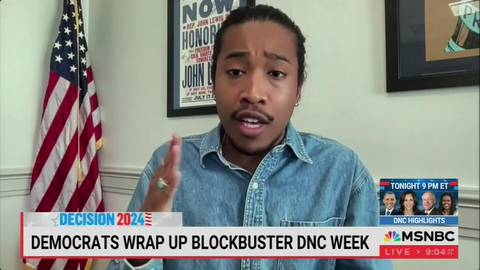
On Saturday afternoon, MSNBC host Katie Phang fawned over her far-left guest, State Representative Justin Jones (D-TN) and declared that she had gone "wild" for him as she lamented that he had failed to secure a speaker's spot at the Democratic National Convention.
She also made an embarrassing verbal gaffe while trying to refer to the "many American flags" at the convention.
After beginning the show by recounting some of the happenings of the convention from this past week, Phang aboard her guest who is famous for taking part in disrupting the Tennessee legislature which led to him and two of his Democrat colleagues being expelled. The MSNBC host posed:
Representative Jones, it's always an honor to have you on the show. Look, I was looking forward to hearing from you as well as the other Tennessee Three. And I know that you guys were not able to actually speak at the convention because of timing. I want you to share with our viewers some kind of thoughts that you were going to say at the convention.
In his response, State Representative Jones complained about the Project 2025 plan for a second Donald Trump term, and talked up the need for Democrats to compete in more Southern states. And, even though Tennessee votes more than 60 Republican in presidential elections, Jones stretched by claiming that it is not actually a red state but instead "voter-suppressed." Here's Jones:
And so, again, our message is to say every state is worth fighting in -- that, you know, when we say we're not going back, that means leaving no state behind and ceding no territory to these extremists, and that Tennessee is not a red state, but it is a voter-suppressed state -- and that if we invest in these Republican-controlled states, we can try to change them. Tennessee has the lowest voter turnout in the nation.
He then called for a laundry list of liberal goals:
If we want to change this nation, we have to look at the South -- Tennessee, Georgia, North Carolina, Mississippi, Alabama -- the South is not going to rise again, Katie, but I do believe it can rise anew. We can build a new South that is multi-racial, multi-generational, rooted in racial justice, rooted in economic justice, rooted in women's rights and LGBTQ rights. And that's the South we're fighting for here in Tennessee.
Following up, Phang gushed:
And the crowd would have gone wild as I am. That would have been amazing, so I'm grateful that you took the time to share that with our viewers tuning in. It was your first convention, Representative. For all of us that were watching at home with a bit of FOMO, tell us how it was to be a part of this historic moment all week.
In his followup, Jones dishonestly claimed that Republicans were trying to ban the teaching of black history:
And of course the Vice President accepting this nomination -- the first black woman, the first South Asian, making history. And, again, Republicans always talk about banning black history, but they cannot ban black history when we are seeing black history being made every day, including on that convention hall floor. It was almost like a pep rally for democracy, and the excitement was electric...
In her next segment in which she discussed Democrats trying to emphasize patriotism and holding many American flags at the convention, Phang accidentally mispronounced the word "flag" as she cheered on a liberal columnist who claimed that Republican patriotism, unlike Democrat patriotism, is "in the gutter."
Transcript follows:
MSNBC's The Katie Phang Show
August 24, 2024
12:02 p.m. Eastern
KATIE PHANG: Joining me now to get us started is Tennessee Democratic State Representative Justin Jones, a member of the Tennessee Three. Representative Jones, it's always an honor to have you on the show. Look, I was looking forward to hearing from you as well as the other Tennessee Three. And I know that you guys were not able to actually speak at the convention because of timing. I want you to share with our viewers some kind of thoughts that you were going to say at the convention.
STATE REPRESENTATIVE JUSTIN JONES (D-TN): Yes, well, it's always an honor to join you, Katie. You know, we will continue to lift up the message that states like Tennessee in the South matter -- that if we want to build a new nation, we cannot neglect the South -- that every state is worth fighting for -- and what we saw last year when we were expelled for fighting for common sense gun laws to protect kids and not guns, what we saw was a real threat that Project 2025 and the authoritarian behavior of MAGA Republican extremists poses to this nation. And so we were going to lift the message for the need to act with urgency and moral clarity and boldness to address the crisis of gun violence and also connecting it to democracy because 70 percent of Americans -- Democrats, Republicans and independents -- are calling for common sense gun laws, and yet Republicans are choosing to answer to the NRA and the gun industry.
And so, again, our message is to say every state is worth fighting in -- that, you know, when we say we're not going back, that means leaving no state behind and ceding no territory to these extremists, and that Tennessee is not a red state, but it is a voter-suppressed state -- and that if we invest in these Republican-controlled states, we can try to change them. Tennessee has the lowest voter turnout in the nation. If we want to change this nation, we have to look at the South -- Tennessee, Georgia, North Carolina, Mississippi, Alabama -- the South is not going to rise again, Katie, but I do believe it can rise anew. We can build a new South that is multi-racial, multi-generational, rooted in racial justice, rooted in economic justice, rooted in women's rights and LGBTQ rights. And that's the South we're fighting for here in Tennessee.
PHANG: And the crowd would have gone wild as I am. That would have been amazing, so I'm grateful that you took the time to share that with our viewers tuning in. It was your first convention, Representative. For all of us that were watching at home with a bit of FOMO, tell us how it was to be a part of this historic moment all week.
JONES: Yeah, I mean, it was my first convention, and as I walked out on the convention floor, it was a sacred space. I was thinking about Fannie Lou Hamer 1964 -- I was thinking about Shirley Chisholm 1972 -- I was thinking about Jesse Jackson 1988 -- all those who led to this moment. And to feel the excitement, you know, I saw clips of the Republican convention, and it was so sad to see how less energy there was -- you know, having Little John come out, having Michelle Obama who lifted up this new call -- "When they go low, we fight back." You know, that's kind of the new energy that we felt from her speech which was a highlight. And of course the Vice President accepting this nomination -- the first black woman, the first South Asian, making history. And, again, Republicans always talk about banning black history, but they cannot ban black history when we are seeing black history being made every day, including on that convention hall floor. It was almost like a pep rally for democracy, and the excitement was electric...
(...)
12:09 p.m.
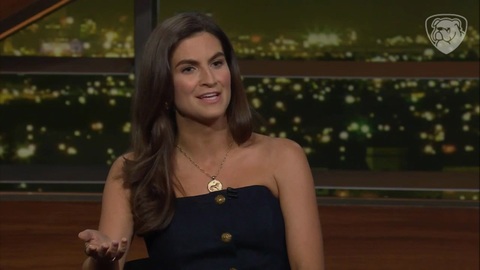
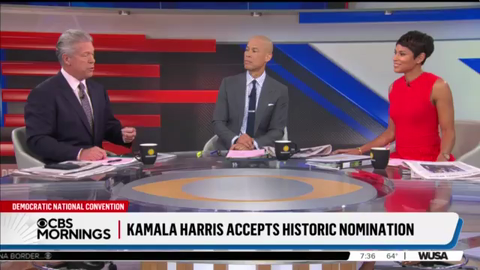
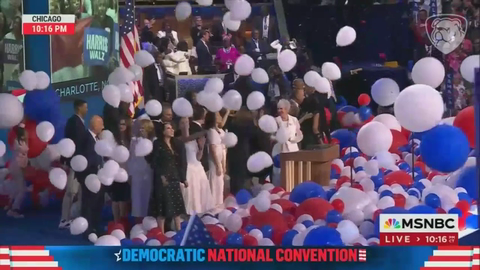
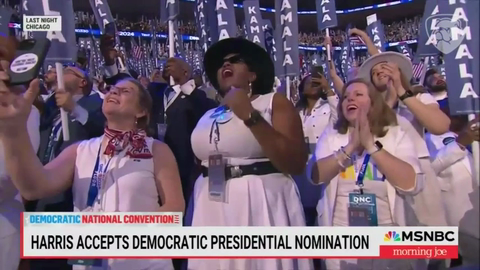
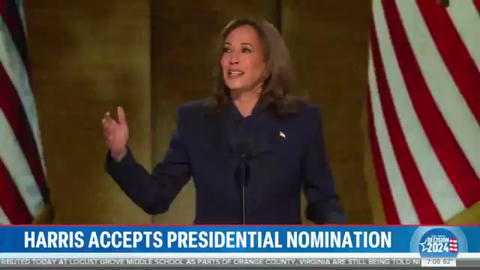
PHANG: At this convention, Democrats reclaimed patriotism from the Republicans. We heard so many chants of "USA." You saw right now on that screen so many American fags -- flags, excuse me -- flying. Republican lieutenant governor of Georgia, Geoff Duncan, telling the crowd, "If you vote for Kamala Harris, you're not voting as a Democrat, but you're voting as a patriot." And, David, quickly, Peggy Noonan, she wrote something that kind of, you know, quicked me a little bit. She says, quote, "The Democrats stole traditional Republican themes of faith and patriotism and claimed them as their own." She wrote that in a Wall Street Journal opinion piece. But David Simon claps back and said, "Those things aren't rationed, Peggy. They're available to all. If Republicans look around for their share, they'll find them in the gutter right where the Republicans toss them." I mean, David, talk about patriotism being reclaimed by the Dems.
The Biden White House allocated $370 billion to clean energy and climate two years ago with the Inflation Reduction Act. Since then, more than 750,000 families have used the new tax benefits to put up solar panels. But one of the groups might surprise you. CNN's Lisa Raffa spoke with faith leaders uniting in climate action.
After noticing more of her patients dealing with the impacts of longer allergy seasons, more extreme heat, and increasing air pollution Dr. Neha Pathak's search for prescriptions took her down a seemingly unconventional path.
Dr. NEHA PATHAK, PRIMARY CARE PHYSICIAN: It can have a big impact on your own personal resilience. So I really looked to my faith tradition to help bolster that resilience for me.
RAFFA: Through that search, this physician in practicing Hindu found herself serving as a board member for Georgia Interfaith Power and Light. Her work towards climate and spiritual solutions is more connected than you might think.
Dr. PATHAK: So the first thing we do when we wake up, one of our prayers is to thank Mother Earth for allowing us to step on her all day long. When we take our first bite of food for the day, we thank Mother Earth for providing us this food.
RAFFA: As the board chair, Rabbi Laurence Rosenthal points out the Bible has been talking about extreme weather for thousands of years with examples like Noah's Ark, plagues, and famine.
RABBI LAURENCE ROSENTHAL, AHAVATH ACHIM SYNAGOGUE: When you read the book of Psalms, it does talk about the thunder and the lightning and the wind and the storms and the sea and all that it's contained, and it really focuses on experiencing God through the environment.
RAFFA: So while solar panels on the roof of this church which may seem like an unlikely intersection between climate, religion and politics, it's actually shining. What are the benefits to your congregation getting solar panels?
RABBI ROSENTHAL: Well, you take yourself off the grid, so we're not continuing to burn coal. The other piece of it is to, in the long term, to lower some of the electrical costs that we have.
RAFFA: The Inflation Reduction Act is the most significant climate legislation Congress has ever passed, making religious institutions eligible for direct pay rebates for the first time -- 117 panels generate 440 watts of energy, offsetting 26 percent of the electricity at this church's campus. That's something that's becoming more common thanks to recent funding from the Inflation Reduction Act. Solar is the fastest growing renewable energy source, up nearly eightfold in the past decade. One forecast shows the Inflation Reduction Act will lead to a 48 precent boost in solar deployment in the next 10 years. In the two years since the new rebates, Georgia Interfaith Power and Light says it has seen a 50 percent increase in faith communities enrolling in their solar wise program. When it comes to the climate crisis, these faith leaders agree. The calling is clear.
We have the science, we understand why this is happening, and now this faith piece is the reverence for the world around us -- the moral call to do the work that aligns with the science.
RAFFA: Why are you as a rabbi so passionate about these environmental issues?
RABBI ROSENTHAL: If I ignore the environmental crisis that we are continuing to wade through, then I'm not taking that charge seriously. I'm not caring for other human beings. The crossroads here between climate, religion and politics just working so well, and, historically, we don't really find that that's the case like for topics like evolution and abortion where that gets a little bit more complicated. Now, the White House noticed that these religious organizations are are really taking on the charge of climate action. John Podesta, senior advisor to Biden on this topic, telling CNN last week that these groups "have been active voices in the climate debate. They're on the front lines of dealing with the effects of extreme weather because they are the ones that are in the disadvantaged communities. And, again, it's not just one religion. We're seeing multiple religions come together and show us that we are much more similar than we might think. Paula?