Cross posted to the MRC's NewsBusters blog
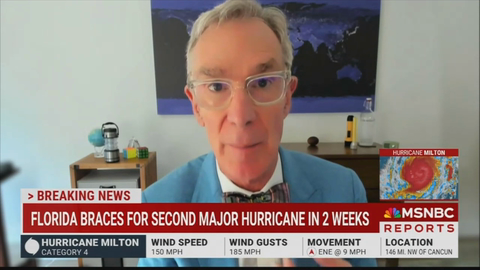
On Wednesday's The ReidOut on MSNBC, fill-in host Jason Johnson gave environmental alarmist Michael Mann a forum to tie fossil fuels to the intensity of Hurricane Milton as the category 3 storm targeted Florida. The MSNBC host began by asking his liberal guest to put into context whether Hurricane Milton really is the "storm of the century" as storms are sometimes described.
The University of Pennsylvania climate researcher began by declaring that the intensity is "the consequence of our ongoing burning of fossil fuels and the warming of the oceans." After explaining that the storm will be more destructive because it spent time as a category 5 for a while before making landfall, Mann reiterated: "So this is a tragedy that is unfolding, and it's a tragedy that was, you know, created in part by our continued burning of fossil fuels and the warming of the planet that's caused."
Johnson then brought up the issue of the term "global warming" evolving into "climate change" as he followed up:
I'm old enough to remember when, you know, we talked about global warming when I was a kid, and then it turned into "climate change," and I think a lot of people didn't understand that climate change didn't mean that things were automatically going to get hotter. It also meant more extreme weather. Talk a little bit about what the consequences are of the increased frequency of these kinds of storms because the fact that we are two weeks away from Helene -- the fact that there were over 100 tornadoes reported in one day in one particular state. If this becomes the norm, what kind of world are we looking at in vast swaths of land in the United States?
Even though there have been other periods of similar hurricane activity, Mann claimed that there is a "new normal" for hurricanes as he argued that it may not be tolerable for much longer unless the burning of fossil fuels is curtailed. He explained:
We're stuck with this new normal. That's the best case scenario. That's a scenario where we stop burning fossil fuels -- we stop warming of the planet further. Then, we're sort of -- we're stuck with this level extreme weather events that we've seen summer after summer. These devastating, stronger, more flood-producing hurricanes -- we're sort of stuck with this, but we can still, you know, we're still within our adaptive, you know, capacity. We can adapt to the changes that we've just witnessed thus far. It's going to take, you know, quite a bit of investment, and there's going to be suffering and harm is done, and we're already seeing that play out. This is a level warmer we can probably adapt to, but if we continue to warm up the planet even more, then pretty soon we're going to exceed our, you know, our level of resilience. And so that's really the problem.
He then added:
These extreme weather events become more extreme. These hurricanes become stronger, the flooding becomes worse. Helene produced 50 percent more rainfall than we would have if we hadn't warmed up the planet. There was a study that came out just last week that demonstrated that. And we know hundreds of people died from that interior flooding -- flooding in very states in the southeastern U.S. That means people are dying because of the warming of the planet that has exacerbated these events. We're already seeing the catastrophic consequences.
But there is nothing unprecedented about the frequency of hurricanes hitting the United States. According to NOAA's list of hurricanes that have made landfall in the U.S. since 1850, in the 25 calendar years from 1999 through 2023, there were 16 hurricanes of at least category 3 strength that made landfall in the United States, compared to 18 between 1945 and 1969. Additionally, between 1999 and 2023, there were seven hurricanes that were at least a category 4 while, between 1945 and 1969, there were 11.
Transcript follows:
7:14 a.m. Eastern
JASON JOHNSON, FILL-IN HOST: What are we looking at in context right now? You know, the term "storm of the century" gets thrown out from time to time. Is that what we're looking at? Are we looking at something that we have not seen before and could have consequences to lives -- to infrastructure to the environment that we've never seen or haven't seen in the lifetimes of those people watching?
PROFESSOR MICHAEL MANN, UNIVERSITY STATE UNIVERSITY: Yeah, hi, Jason. It's good to be with you. And what we're witnessing in tragic, and it is the consequence of our ongoing burning of fossil fuels and the warming of the oceans.
(...)
So this is a tragedy that is unfolding, and it's a tragedy that was, you know, created in part by our continued burning of fossil fuels and the warming of the planet that's caused.
JASON JOHNSON, FILL-IN HOST: You know, Professor Mann, I'm old enough to remember when, you know, we talked about global warming when I was a kid, and then it turned into "climate change," and I think a lot of people didn't understand that climate change didn't mean that things were automatically going to get hotter. It also meant more extreme weather. Talk a little bit about what the consequences are of the increased frequency of these kinds of storms because the fact that we are two weeks away from Helene -- the fact that there were over 100 tornadoes reported in one day in one particular state. If this becomes the norm, what kind of world are we looking at in vast swaths of land in the United States?
MANN: Yeah, and I'll tell you, you know, what we're witnessing now, we're sort of stuck with. We're stuck with this new normal. That's the best case scenario. That's a scenario where we stop burning fossil fuels -- we stop warming of the planet further. Then, we're sort of -- we're stuck with this level extreme weather events that we've seen summer after summer. These devastating, stronger, more flood-producing hurricanes -- we're sort of stuck with this, but we can still, you know, we're still within our adaptive, you know, capacity. We can adapt to the changes that we've just witnessed thus far. It's going to take, you know, quite a bit of investment, and there's going to be suffering and harm is done, and we're already seeing that play out. This is a level warmer we can probably adapt to, but if we continue to warm up the planet even more, then pretty soon we're going to exceed our, you know, our level of resilience. And so that's really the problem.
These extreme weather events become more extreme. These hurricanes become stronger, the flooding becomes worse. Helene produced 50 percent more rainfall than we would have if we hadn't warmed up the planet. There was a study that came out just last week that demonstrated that. And we know hundreds of people died from that interior flooding -- flooding in very states in the southeastern U.S. That means people are dying because of the warming of the planet that has exacerbated these events. We're already seeing the catastrophic consequences.
JOHNSON: Michael Mann, thank you for that sobering but very important message about what we're facing as a planet.