Cross posted to the MRC's NewsBusters blog
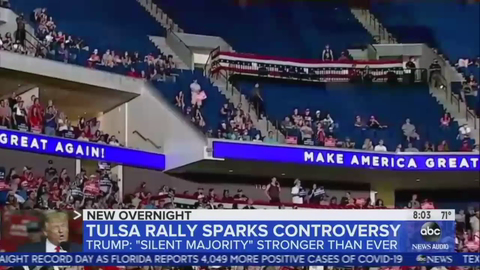
Over the past week, as journalists and liberal commentators have been fixated on the timing and location of President Donald Trump's campaign rally on Juneteenth weekend in Tulsa, Oklahoma, they have again been peddling the debunked myth that President Ronald Reagan launched his 1980 presidential campaign in Philadelphia, Mississippi, in an effort to appeal to white racism.
Citing the fact that Tulsa was a city where a horrific mass murder of black residents occurred in 1921, a number of figures on MSNBC have likened the Trump rally to Reagan's 1980 campaign event.
On Friday evening as she was fill-in host for the 7:00 p.m. time slot, MSNBC's Joy Reid recalled:
He goes to Philadelphia, Mississippi -- the same place where those three civil rights workers were murdered -- he goes there in 1980 to kick off his campaign. … And he talks about believing in states' rights. "I believe in states' rights." He rallies to this all-white crowd...
On the same evening on The Beat, MSNBC correspondent agreed with Brittney Cooper of Rutgers University after she railed against Reagan over his Philadelphia speech:
BRITTNEY COOPER, RUTGERS UNIVERSITY: This is actually part of a more recent Republican playbook that when you want to tell your base that you are not on board with African American freedom movements, you go to a place that is significant for the struggle for black freedom and civil rights and then you declare things that are absolutely opposite and antithetical to that.
TRYMAINE LEE, MSNBC CORRESPONDENT: Brittney is always so eloquent and forceful and spot on everything she said.
Also on Friday's Amanpour & Co., PBS host Christiane Amanpour allowed Columbia University's Eric Foner to repeat the Reagan smear.
But the myth that Reagan began his campaign at a site where civil rights activists were murdered so he could appeal to white racists is wrapped in several falsehoods.
First, liberals try to hype the timing of the August 3, 1980, speech by claiming that this was either where Reagan announced his candidacy for President, or that it was his first appearance after the Republican National Convention -- neither of which is true. The Gipper announced his presidential campaign in November 1979, and his Philadelphia speech came after several other campaign stops in the aftermath of the July convention, so it wasn't even the beginning of the general election campaign.
Secondly, rather than being held at a location that was just known for being near an infamous murder scene, the speech was held at the biggest public event in the state, the Neshoba County Fair, which was the best place to get exposure to voters from all over Mississippi at a time when the state was more competitive in presidential elections. In fact, Democrats John Glenn and Michael Dukakis also campaigned at the state fair years later as they ran for President.
Third, Reagan's speech did not deal with racial or civil rights issues, but, in fact, was focused on the federal government dictating to state governments on economic and education issues. This was consistent with his previous history of speaking in favor of "states' rights" while complaining that the federal government collects too much tax revenue from the states and then only gives some of it back with strings attached.
And, contrary to how journalists tried to spin it, Reagan's use of the term "states' rights" was not a phrase he only uttered near Southern whites who might have supported George Wallace when, in fact, he had a documented history of sometimes using the phrase in other venues that would have reached plenty of non-Southerners as well.
On February 28, 1980, he used the term during one of the Republican presidential debates that, according to moderator Jim Lehrer, was being broadcast on PBS stations not only in South Carolina, but was "also being carried elsewhere in the country on many station members of the Public Broadcasting Service."
Liberal columnists William Raspberry and Jack Germond took part in moderating the debate, but there's no sign that any journalists took notice of Reagan's use of the phrase "states' rights" as he answered a question about whether states should be able to refuse to accept nuclear waste (according to the Nexis transcript): "While I'm a believer in states' rights, I have to recognize that there are many states that actually do not have the terrain or do not have the places that would be proper storage places for that waste."
Earlier in the debate, the candidates were notably invited to make a pitch for the votes of black South Carolinians, leading Reagan to brag about his history of appointing minorities when he was governor of California.
And, as far back as 1967, then-Governor Reagan discussed the issue of "states' rights" with conservative author William F. Buckley, Jr., on the syndicated show, Firing Line, which at the time was mostly seen in New York.
Reagan also used the phrase in a number of speeches while he was President.
What makes so brazen the effort by liberals to twist Reagan's harmless speech into a racist one is the fact that then-Democratic President Jimmy Carter himself made a campaign appearance with actual segregationists on Labor Day as he shared a stage with former Alabama Governor George Wallace, former Alabama Senator John Sparkman, and former Mississippi Senator James O. Eastland in Tuscumbia, Alabama.
Eastland, of particular note, had notoriously dismissed the disappearances of Chaney, Goodman, and Schwerner as a "publicity stunt" after they were first reported missing while he was a U.S. Senator in 1964.
Below are recent examples of media figures peddling the myth of Reagan's Philadelphia speech:
PBS/CNN International
Amanpour & Co.
June 19, 2020
CHRISTIANE AMANPOUR: Do you think the fact that President Trump was going to have his rally not just on Juneteenth -- of course it's been postponed till tomorrow -- but also, in a city that is the center of one of the worst massacres of black residents by white neighbors -- of course that was like 1921 -- but that, I mean, can that be an accident?
ERIC FONER, COLUMBIA UNIVERSITY PROFESSOR EMERITUS OF HISTORY: I don't think that President Trump is well-educated in American history, so I can well believe that he personally did not know much about the Tulsa massacre. On the other hand, I do believe that there were people in his entourage in the White House who certainly did know. When I heard that he had chosen Tulsa, what it reminded me of was how Ronald Reagan in 1980 launched his presidential campaign in Philadelphia, Mississippi, which was the site of, you know, the murder of three civil rights activists during Freedom Summer of 1964.
Launching your campaign -- or relaunching it in the Trump case -- in a place like that sends a message. It's a subliminal message -- it's not overt, but it sends a message about who you think your supporters are and what is important to you. So I don't think the choice of Tulsa is just an accident or inadvertent. It sends a message not that President Trump approves of the massacre of hundreds of people, but just, you know, of which side are you on fundamentally, and choosing Tulsa tells us something about that.
(…)
MSNBC
America in Crisis
June 19, 2020
7:50 p.m. Eastern
JOY REID: There's also this sort of way that memory is used for politics on the other side of it -- that white memory is used to flip even horrible events to say, "No, no, this is how we're looking out for you." I'm going to give you an example. Ronald Reagan -- who people forget, you know, he was elected 12 years after King was assassinated, not like 100 years after -- like 12 years after -- and not long after the Goodman, Schwerner and Chaney murders in Mississippi, he goes to Mississippi.
He goes to Philadellphia, Mississippi -- the same place where those three civil rights workers were murdered -- he goes there in 1980 to kick off his campaign. I think we have some B roll of that. And he talks about believing in states' rights. "I believe in states' rights." He rallies to this all-white crowd, and then here's just a little bit of his speech.
RONALD REAGAN: I'm going to behoove myself to trying to reorder those priorities and to restore for states and local communities those functions that properly belong there.
REID: It is very hard for me to believe, Jelani, that it is accidental that Donald Trump -- surrounded by the quote, "alt-right" people that are around him -- accidentally tried to plan a rally in Tulsa on Juneteenth because that is the history that the Republican party -- they've used it before. You know, the Dixiecats used to use it. It's been used before.
JELANI COBB, COLUMBIA UNIVERSITY JOURNALISM PROFESSOR: Sure. It's a kind of knockoff of the Reagan move, and that was immediately what I read it as when I saw it. And, you know, this is not surprising. It is not shocking. It's the same thing when you saw people take the Martin Luther King holiday and turn it into confederate appreciation day, so it's trolling.
(…)
MSNBC
The Beat
June 19, 2020
6:13 p.m.
BRITTNEY COOPER, RUTGERS UNIVERSITY ASSOCIATE PROFESSOR: When the young woman in Detroit talked about Donald Trump's dog whistle in terms of coming to the place of Black Wall Street to have this rally -- for folks who think that that's so unique and so shocking, remember that Ronald Reagan went in the 1980s to Philadelphia, Mississippi, the place where Chaney, Goodman, and Schwerner goes -- those wonderful luminaries of civil rights were killed -- to declare that he still supported states' rights.
So this is actually part of a more recent Republican playbook that when you want to tell your base that you are not on board with African American freedom movements, you go to a place that is significant for the struggle for black freedom and civil rights and then you declare things that are absolutely opposite and antithetical to that.
ARI MELBER: Trymaine?
TRYMAINE LEE, MSNBC CORRESPONDENT: Brittney is always so eloquent and forceful and spot on everything she said
(…)
The McLaughlin Group
June 12, 2020
ELEANOR CLIFT, THE DAILY BEAST: Tulsa is the site of a white uprising mob violence against black people 99 years ago, and what it reminds me of is that President Reagan -- actually candidate Ronald Reagan opened his 1980 presidential campaign in Neshoba County, Mississippi, which was right near Philadelphia, Mississippi, where the three civil rights workers were murdered.
(…)
MSNBC
MSNBC Live with Stephanie Ruhle
June 12, 2020
9:12 a.m.
CORNELL BELCHER, MSNBC CONTRIBUTOR: What kind of signaling is he doing when he's doing this on Juneteenth, and he's doing it in Tulsa where famously, you know, where Black Wall Street was, and there was a massacre there? I mean, it does remind me of Ronald Reagan going to Philadelphia, Mississippi, site of the infamous civil rights murders, and talking about states' rights. I think it is abhorrent, the signaling that the President is doing right now, and I don't think that can be excused.
WH Trade Advisor: China ‘Spawned’ Coronavirus, ‘Open Question’ if it Was Deliberate
. patrick.goodenough