Cross posted to the MRC's NewsBusters blog
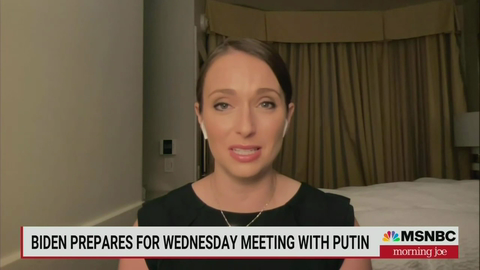
After the release of a report exonerating President Donald Trump over the clearing of left-wing protesters in Lafayette Park last year, Carol Leonnig of the allegedly "neutral" Washington Post went on MSNBC to express her doubts about the report's credibility.
As she discussed the findings with MSNBC host and liberal caricature Chris Hayes, both she and Hayes at times seemed like they had barely read the report they were trashing, which actually answered some of the questions they speculated about. At one point, Leonnig complained:
And the question that continues to be left unanswered from this report, Chris, is: "Why the urgency, right?" If it wasn't to move things, you know, out of the way for the President's movement, why did they have to use, you know, pepper spray? Why did they have to use rubber munitions? Why did they have to use shields to shove peaceful protesters as quickly as possible out of this area about 20 minutes before the President emerged?
It was explained in the report that a decision was made days earlier that they wanted to prevent a repeat of the violence from previous nights that had included the injury of at least 49 officers and someone setting fire to the church. The fencing company they were employing wanted to begin constructing the anti-scale fence while it was still light outside, and with plenty of police protection for its workers.
But the fencing did not arrive until the afternoon of June 1, and there were not enough Federal officers available until later in the afternoon because so many had been working overtime on previous days and needed rest. The plan was to clear the park as soon as they arrived.
Federal officers were ordered to be restrained in their treatment of protesters by not using teargas and only using pepper spray if protesters turned violent.
The report also recounts observations that, in spite of the fact that the 7 p.m. curfew was approaching, more people were arriving, and, as had happened on previous days, violence increased in the afternoon, making it likely that additional delay would have only made the situation more difficult to handle.
At one point, Hayes suggested that a "bullhorn" should have been used to clear protesters:
I mean, to your point, if you're going to build a fence and you want to increase a perimeter area, right, you can take your time doing that. I mean, you can send people out with a bull horn. You can start to tape things off. There's a bunch of ways you could do that that don't require this very quick, decisive, suddenly announced action that we, again, all saw the Park Police take with our own eyes.
But the report recalls that a "sound-amplifying long-range acoustic device" was borrowed from the D.C. Police and was used to give three warnings to clear the park, but, in one of the failures noted by the report, the equipment was not loud enough for many protesters to hear it, making it appear they were suddenly rushed by Federal officers for no reason. Hayes could have seen this from just reading the first page.
It also seemed to go over the heads of both liberal journalists that the synchronized timing of President Donald Trump marching to the church after the park was cleared does not prove he was the one who initially ordered it, or that that was the reason the action was decided on. He most likely would have been informed about the plans, and therefore might have decided to take advantage of the clearing action that was going to be done anyway.
Earlier in the day, MSNBC host Joe Scarborough also notably mocked the report on his Morning Joe show.
This episode of MSNBC's All In with Chris Hayes was sponsored in part by Nervive. Their contact information is linked.
MSNBC
All In with Chris Hayes
June 10, 2021
8:24 p.m.
CAROL LEONNIG, WASHINGTON POST NATIONAL INVESTIGATIVE REPORTER: : The White House was planning Monday morning for this perimeter to be pushed. The President was planning for a movement to project his control over the city. He was doing that around 2:00 with his White House aides. And between 3:00 and 5:00, the White House Secret Service and the deputy chief of staff, who is the former Secret Service detail leader for the President, were letting the Park Police most senior leaders know, "Hey, by the way, the President's going to be coming out."
The President is their boss. And the question that continues to be left unanswered from this report, Chris, is: "Why the urgency, right?" If it wasn't to move things, you know, out of the way for the President's movement, why did they have to use, you know, pepper spray? Why did they have to use rubber munitions? Why did they have to use shields to shove peaceful protesters as quickly as possible out of this area about 20 minutes before the President emerged?
CHRIS HAYES: Right. I mean, that's one of many logical holes here. I mean, to your point, if you're going to build a fence and you want to increase a perimeter area, right, you can take your time doing that. I mean, you can send people out with a bull horn. You can start to tape things off. There's a bunch of ways you could do that that don't require this very quick, decisive, suddenly announced action that we, again, all saw the Park Police take with our own eyes.
LEONNIG: Absolutely. And, you know, keep in mind, there are many things about this report that are accurate. There was a discussion starting on Saturday that, you know, "We've had a lot of violence on Friday night after the George Floyd protests began outside the White House." There was a lot of feeling at the Secret Service and also in the Park Police, but especially the Secret Service, that "we were overwhelmed. We would not have been able at the Secret Service to stop a series of protesters from jumping the fence en masse. We would have been swarmed and overwhelmed." So there was concern about how to establish this perimeter.
But let's be clear. The Secret Service and the Park Police have been trained how to move protesters carefully to another location safely where they can exercise their First Amendment rights. And this did not follow any of those norms. It did not follow any of their training. And, in fact, as my book reveals, the Secret Service officers and agents pressed their director after June 1 in a town hall meeting to explain, "What is our use of force policy exactly?" because this didn't look like it.
HAYES: Yeah, that's a great point. The final thing I would just say here again -- and not to sort of center on the logic as opposed to the facts -- but just at a logical level, the "but for" relationship -- the causal relationship -- is like, obviously, if they hadn't cleared that area, the President wasn't going to it, right? Like, that is an obvious -- that is such an obvious point. He's not going to walk out like, "Hey, everybody, I'm in the middle of the protest." Like, obviously, there's a relationship between the two at some level.
LEONNIG: One hundred percent. The Secret Service director and the Secret Service detail leader would throw down their badges and quit rather than take the President into an area where any of these protesters were.